Motor vehicle crashes remain the leading cause of death for children aged 1 to 13 in the United States. Proper child safety seat use reduces fatal injury risk by 58% to 71% for infants and 54% to 59% for toddlers compared to no restraint, yet nearly half of all car seats are installed incorrectly.
Selecting the appropriate seat type, understanding evolving state regulations, and ensuring correct installation present significant challenges for caregivers. This guide synthesizes current federal guidelines, independent crash test data, and manufacturer specifications to provide clear direction on protecting young passengers.
From rear-facing infant carriers to belt-positioning boosters, each transition point carries specific weight limits, height requirements, and legal obligations that vary by jurisdiction.
What Are the Different Types of Child Safety Seats?
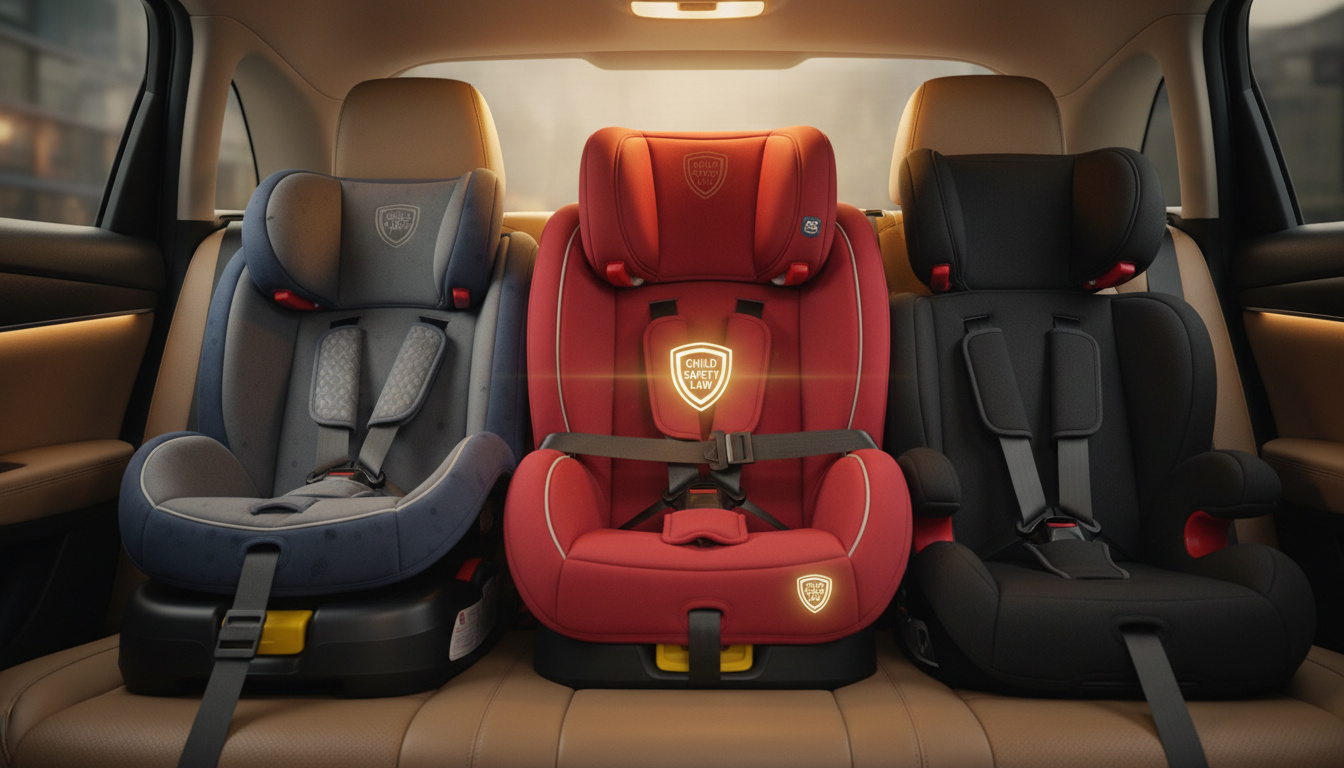
Child safety seats are categorized by orientation, restraint method, and developmental stage accommodation. Manufacturers design distinct architectures for infants versus older children, with some models converting between stages to extend usability.
Infant-Only Seats
Rear-facing only, designed for newborns to approximately 12 months. These portable carriers cradle the head and neck to reduce crash stress on fragile spines and spinal cords. CDC research confirms this orientation distributes collision forces across the entire back.
Convertible Seats
Systems transitioning from rear-facing (birth to age 2-4) to forward-facing with harness. Weight accommodation typically ranges from 4 to 65 pounds depending on orientation, allowing extended rear-facing duration as recommended by the National Highway Traffic Safety Administration.
Booster Seats
Belt-positioning devices for ages 4-12. These elevate children so lap belts rest across upper thighs rather than the stomach, and shoulder belts cross the chest rather than the neck or face. Usage reduces injury risk by 45% for children aged 4-8 compared to seat belts alone.
All-in-One Systems
Multi-stage units converting from rear-facing to forward-facing to high-back or backless booster configurations. Extended use ranges from birth through pre-teen years, though IIHS data emphasizes proper fit verification at each transition.
Independent testing organizations evaluate these categories for crash performance and usability. BabyGearLab and Consumer Reports conduct controlled collision analysis to identify models demonstrating superior protection.
- 58-71% reduction in fatal injury risk for infants using proper restraints versus no restraint, per Insurance Institute for Highway Safety analysis.
- 325 children under age 5 are saved annually by car seats and booster seats according to NHTSA estimates.
- 45% lower injury risk for children aged 4-8 using booster seats compared to seat belts alone.
- 50% installation error rate persists despite LATCH system availability, primarily due to loose securing or incorrect harness height.
- Rear seats reduce fatal risk by 75% for children 0-3 years compared to front seat placement.
- 43% of crash deaths among children under 13 in 2023 involved unrestrained passengers.
- 6-10 year lifespan typical for plastic shells and harness systems before expiration.
| Specification | Standard/Requirement | Source |
|---|---|---|
| Rear-Facing Duration | Minimum age 2-4 years within manufacturer limits | NHTSA Guidelines |
| Forward-Facing Transition | After outgrowing rear-facing limits, until at least age 5 | CDC |
| Booster Requirements | Until seat belt fits properly, typically 4’9″ height | IIHS |
| LATCH Weight Limit | 65 pounds combined child and seat weight | FMVSS |
| Seat Expiration | 6-10 years from manufacture date | Manufacturer Guidelines |
| Airbag Restriction | Never place rear-facing seats in front passenger position | NHTSA/IIHS |
| Fatal Risk Reduction (Rear Seat) | 75% lower for ages 0-3; 50% lower for ages 4-8 | IIHS |
| Annual Lives Saved | 325 children under 5 | NHTSA |
| Top Tether Requirement | Mandatory for forward-facing installations | NHTSA Technical Standards |
| Vehicle Compatibility | Minivans and SUVs demonstrate superior LATCH accessibility | Cars.com Analysis |
What Are Child Safety Seat Laws and Requirements?
All 50 states mandate child restraint devices for young passengers, though specific age, weight, and height thresholds vary significantly by jurisdiction. No uniform federal law dictates nationwide standards, creating a complex regulatory landscape for families traveling across state lines.
Federal Guidelines vs. State Variations
Federal agencies establish baseline recommendations: rear-facing positioning from birth until age 2-4, forward-facing harness systems until at least age 5, and booster seats until adult belts fit correctly. However, state statutes diverge in enforcement specifics. Some jurisdictions mandate rear-facing until age 2 specifically, while others require boosters until children reach 4’9″ or age 8. Unrestrained children accounted for 43% of crash fatalities among passengers under 13 in 2023.
While all states mandate child restraint devices, specific age and height thresholds differ significantly. Caregivers should verify current requirements through their state DMV or the NHTSA state law directory.
Compliance and Enforcement
Primary enforcement states allow officers to stop vehicles solely for restraint violations, while secondary enforcement requires additional traffic infractions. Penalties range from fines to mandatory safety education courses. Checkpoints and saturation patrols focus particularly on booster seat compliance for children aged 4-8, where transition confusion frequently results in premature seat belt usage.
How Do You Properly Install a Child Safety Seat?
Two primary methods secure child safety seats: the Lower Anchors and Tethers for Children (LATCH) system or the vehicle seat belt. LATCH provides standardized attachment points in compatible vehicles manufactured after 2002, utilizing lower anchors and a top tether for forward-facing installations. Alternatively, seat belt installation proves equally safe when executed correctly, particularly for heavier children exceeding the 65-pound combined weight limit for lower anchors.
Critical Installation Errors
Despite technological advances, approximately 50% of child safety seats remain improperly installed. Common errors include loose installation allowing excessive movement, incorrect harness height positioning, and placing rear-facing infants in front seats exposed to active airbags. The top tether strap, required for forward-facing seats, significantly reduces head excursion during collisions yet remains frequently unused.
Never install rear-facing child safety seats in the front passenger position of vehicles with active airbags. Deployment forces can cause catastrophic injury to infants. The rear middle seat remains the safest position for children under 13.
Verification Protocols
For caregivers seeking additional portable safety solutions beyond vehicle use, the Portier Baby Carrier – 2025 Safety Review and Guide offers independent analysis of wearable restraint systems. Certified Child Passenger Safety Technicians provide free inspection services at hospitals, fire stations, and community events to verify correct angle, tightness, and harness routing.
When Should You Replace Your Child Safety Seat?
Child safety seats carry expiration dates typically ranging from 6 to 10 years from manufacture, molded into the plastic shell or labeled on the base. UV exposure, temperature cycling, and material fatigue degrade structural integrity over time, compromising crash performance. Parents should verify these dates during initial purchase and periodic inspections.
Post-Collision Protocols and Recalls
Replacement becomes mandatory following moderate to severe vehicle collisions, even if the seat appears undamaged. Micro-fractures in the plastic shell or stretched harness webbing may not show visible signs but fail under subsequent impact forces. Additionally, caregivers must register new seats with manufacturers to receive recall notifications. The NHTSA recall checker provides verification against current safety alerts.
Manufacturers cannot notify owners of defects without registration records. Complete the registration card included with purchase or submit online immediately after installation to ensure recall notifications reach you directly. To ensure you’re always informed about potential safety updates, it’s crucial to register your child’s car seat with the manufacturer, and you can find more details on this and other safety topics at $early signs of pregnancy.
Emergency preparedness extends beyond seat maintenance. Keep the NRMA Contact Number – Roadside, Claims & Membership Lines accessible for immediate assistance during roadside emergencies involving child passengers.
How Have Child Safety Standards Evolved?
- Early federal standards established basic structural requirements for child restraints, though compatibility and installation consistency remained limited.
- Introduction of the LATCH (Lower Anchors and Tethers for Children) system began phasing in, providing standardized attachment points independent of seat belts.
- Federal mandate required all new vehicles and child seats to include LATCH compatibility, standardizing installation hardware.
- State-level booster seat laws expanded significantly, extending requirements to children up to 8 years or 4’9″ in height.
- Updated NHTSA guidelines emphasized extended rear-facing duration and strengthened side-impact protection testing protocols for new seat models.
What Do We Know vs. What Remains Unclear?
| Established Evidence | Remaining Uncertainties |
|---|---|
| Rear-facing reduces infant fatal injury by 58-71% compared to no restraint, and forward-facing harness systems reduce risk by 54-59% for toddlers. | Precise comparative effectiveness between LATCH and seat belt installation methods in real-world crash scenarios remains under study. |
| Booster seats reduce injury risk by 45% for children aged 4-8 versus seat belts alone. | Long-term developmental effects of prolonged rear-facing positioning beyond age 4 require additional longitudinal research. |
| All states mandate child restraint use, with specific age and height thresholds varying by jurisdiction. | Uniform federal standards preempting state variations have not been established, creating compliance complexity for interstate travel. |
| Seats expire after 6-10 years due to plastic degradation and harness wear. | Exact lifespan varies by climate exposure and storage conditions; no standardized visual inspection criteria exist for consumers to assess material fatigue. |
Why Child Passenger Safety Requires Vigilance
Motor vehicle collisions represent the leading mortality cause for American children aged 1 through 13. While child safety seats demonstrably save lives—approximately 325 children under 5 annually—the protective benefit depends entirely on correct selection, installation, and maintenance. The disparity between theoretical safety ratings and real-world effectiveness stems from the high error rate in consumer installation.
Global standards vary significantly, with European regulations emphasizing different crash test criteria and Australian systems requiring unique tethering methods. In the United States, the intersection of federal recommendations, state mandates, and rapidly evolving product technologies creates a complex compliance landscape for parents and caregivers.
Expert Perspectives on Restraint Efficacy
Proper use saves lives. Maximizing the time children spend in each restraint stage—rear-facing, forward-facing, booster—within manufacturer limits provides optimal protection.
— National Highway Traffic Safety Administration
Children should remain rear-facing until they reach the maximum height or weight allowed by the seat manufacturer, typically beyond age 2.
— American Academy of Pediatrics
The rear seat is the safest place for children. Properly used child restraints reduce fatal injury risk by more than half for young children compared to riding unrestrained.
— Insurance Institute for Highway Safety
Essential Actions for Child Passenger Protection
Caregivers must match seat types to current child measurements rather than age alone, verify installation using manufacturer manuals or certified technician assistance, register products for recall notifications, and replace seats immediately following expiration or vehicle collisions. Regular inspection of harness fit and securement prevents the 50% error rate observed in community safety checks.
Frequently Asked Questions
What is the best child safety seat?
Top crash-tested models include the Graco 4Ever DLX convertible system, Chicco KeyFit 30 infant carrier, and Britax Boulevard ClickTight with anti-rebound bar. Road & Track evaluations confirm selection depends on vehicle compatibility, child measurements, and proper fit.
What are common child safety seat mistakes?
Loose installation permitting excessive movement, incorrect harness height positioning, placing rear-facing infants in front seats with active airbags, and failing to use the top tether for forward-facing seats constitute the most frequent errors.
How long do child safety seats last?
Most seats expire 6 to 10 years from the manufacture date stamped on the shell or label. Plastic degradation and harness wear compromise structural integrity beyond this period regardless of visible condition.
Can you use a child safety seat without LATCH?
Yes. Seat belt installation provides equivalent protection when executed correctly. LATCH simplifies attachment but becomes unavailable once the combined weight of child and seat exceeds 65 pounds.
What weight limits apply to child safety seats?
Infant-only seats typically accommodate 22-35 pounds. Convertible seats range 4-65 pounds (rear-facing to forward-facing). Booster seats serve children from 40-120 pounds until adult belts fit properly.
What to look for in a child safety seat?
Verify NHTSA ease-of-use ratings, check vehicle compatibility for installation method, ensure appropriate height/weight limits for your child’s current measurements, and confirm the manufacture date allows full useful lifespan before expiration.

Laura Webb covers business, markets and economic policy for Reef Brief.