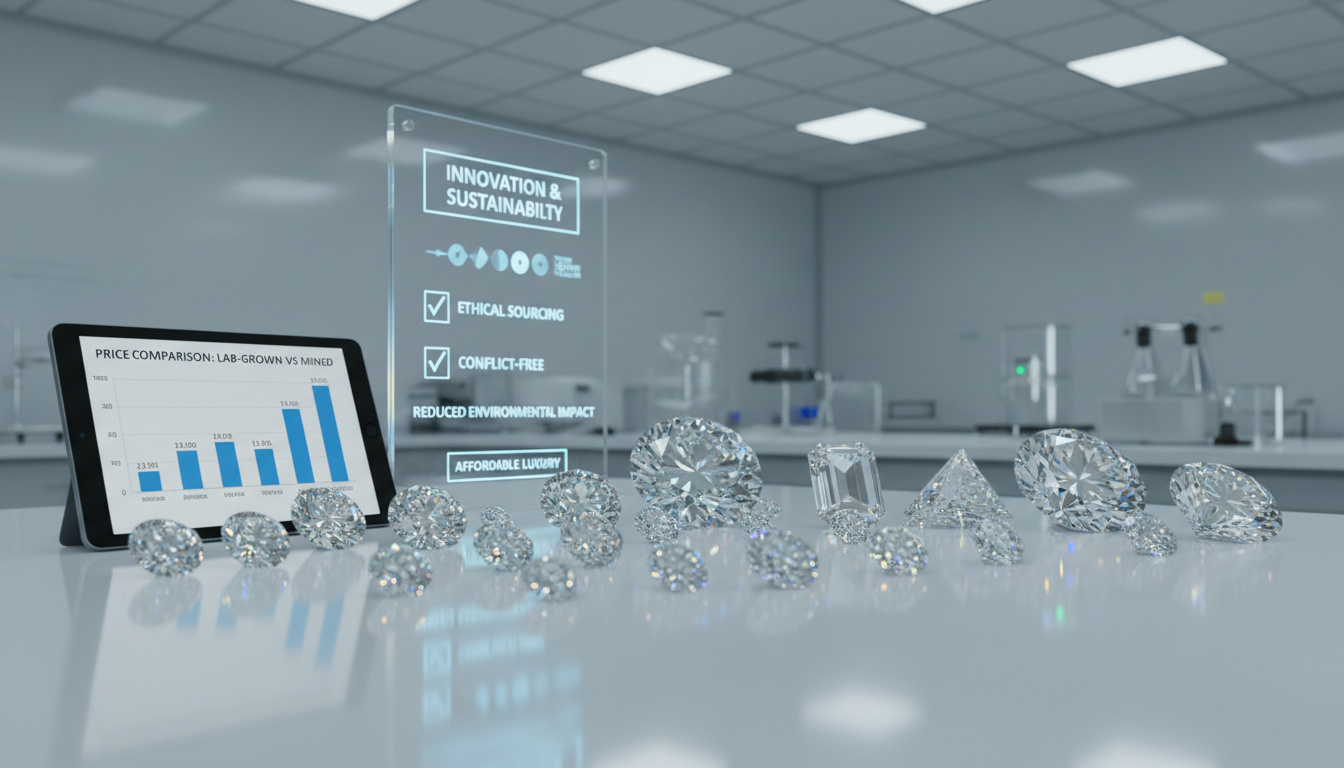

Lab-grown diamonds have moved from industrial curiosity to mainstream jewelry staple. These stones are chemically, physically, and optically identical to their mined counterparts, rating 10 on the Mohs hardness scale for durability and brilliance.
The distinction lies in origin and cost. While natural diamonds form over billions of years beneath the earth’s crust, laboratory versions crystallize within two to six weeks. This accelerated timeline translates to substantial savings, with consumers paying 80 to 95 percent less for equivalent carat weights in 2025, according to industry pricing data.
Yet price is not the only factor driving adoption. Ethical considerations, environmental impact, and shifting generational values have positioned lab-created stones as a disruptive force within the $370 billion global diamond industry.
Are Lab Grown Diamonds Real?
| Definition Chemically identical crystalline carbon |
Production HPHT and CVD laboratory methods |
Cost 80-95% less than mined equivalents |
Certification Graded by GIA and IGI using 4Cs standards |
- The Federal Trade Commission ruled in 2018 that lab-grown stones qualify as “real diamonds,” removing the requirement to label them “natural”
- Gemological Institute of America reports indicate 60 percent of lab-grown diamonds achieve VS1 clarity or higher
- Market share reached 48 percent of engagement ring sales in 2025, per Rapaport industry analysis
- Average lab-grown stone size now ranges between 2.0 and 2.45 carats, exceeding the 1.6 carat average for natural stones
- Production concentrates in China and India, accounting for over 70 percent of global output
- Carbon footprint measures approximately 72 kilograms per carat compared to 125 kilograms for mined stones
- Gen Z couples choose lab-grown options at rates exceeding 50 percent, representing a 40 percent increase since 2019 according to Fortune’s coverage of McKinsey research
| Aspect | Lab-Grown Diamonds | Natural/Mined Diamonds |
|---|---|---|
| Chemical Composition | Crystallized carbon (C) | Crystallized carbon (C) |
| Mohs Hardness | 10 | 10 |
| Production Time | 2-6 weeks | 1-3 billion years |
| Price (1-carat, 2025) | $800-$2,000 | $4,000-$9,000 |
| Resale Value | Depreciating (15-20% annually) | Better retention as rare assets |
| CO2 per Carat | 72 kg | 125 kg |
| Water Use | Minimal | 480 liters |
| Nitrogen Content | Often nitrogen-free | Trace nitrogen present |
| Market Share (Engagement) | 48% in 2025 | Declining |
| Origin | Laboratory (China/India 70%+) | Subsurface geological formation |
Lab Grown vs Natural Diamonds: Key Differences
Formation Time and Environmental Impact
Natural diamonds require one to three billion years of high-pressure, high-temperature conditions deep within the mantle. Laboratory diamonds replicate these conditions in specialized growth chambers, completing the process in weeks rather than eons.
This compressed timeline reduces land disruption and water consumption. However, energy intensity varies significantly by facility location and power source, complicating straightforward environmental comparisons.
Visual and Physical Identification
To the unaided eye, the stones remain indistinguishable. Both possess identical refractive indices and hardness ratings. Specialized gemological equipment detects differences at the atomic level; natural diamonds typically contain trace nitrogen impurities, while lab-grown specimens often develop in nitrogen-free environments. Specialized laboratories remain the only reliable method for distinguishing between the two.
Market Value and Size Trends
The price differential has widened significantly. In 2020, lab-grown stones sold at 50 to 60 percent discounts to natural equivalents. By 2025, that gap expanded to 80 to 95 percent, with wholesale prices for one-carat VS1 near-colorless stones dropping 95 percent since 2018. Consequently, consumers purchase larger stones; the average lab-grown engagement ring diamond now exceeds two carats.
Standard jewelry appraisers cannot distinguish lab-grown from natural diamonds without advanced spectroscopic equipment. The Gemological Institute of America and similar bodies require specialized testing to detect growth method signatures.
How Are Lab Grown Diamonds Made?
High Pressure High Temperature (HPHT)
This method places a diamond seed within a press subjected to temperatures exceeding 1,500 degrees Celsius and pressures above 1.5 million pounds per square inch. A carbon source melts and precipitates onto the seed, growing layer by layer. HPHT diamonds may contain metallic flux inclusions as a byproduct of the growth medium.
Chemical Vapor Deposition (CVD)
CVD processes suspend diamond seeds in a plasma chamber filled with carbon-rich gas, typically methane. Microwave energy heats the chamber to approximately 800 degrees Celsius, causing carbon atoms to settle and crystallize on the seed. This method produces stones with fewer metallic inclusions, though strain patterns may appear under magnification.
2025 Manufacturing Innovations
Recent technological advances include microwave plasma CVD systems operating 40 percent faster than previous generations, according to Langerman Diamonds analysis. Multi-seed growth platforms now cultivate over 50 diamonds simultaneously, driving production capacity toward 15 to 20 million carats annually by 2030.
HPHT stones may display metallic inclusions visible under magnification, while CVD diamonds occasionally show strain patterns. Neither affects durability, but gemologists use these markers for identification.
Do Lab Grown Diamonds Hold Value?
Depreciation and Resale Trends
Investment potential remains the primary uncertainty. Wholesale values have declined 95 percent since 2018, with prices projected to fall an additional 15 to 20 percent annually through 2030. Unlike natural diamonds, which maintain position as scarce geological assets, lab-grown stones face continuous depreciation as production scales.
Ethical and Environmental Considerations
Lab-grown diamonds offer conflict-free sourcing by default, eliminating concerns associated with artisanal mining operations. Supply chains remain transparent and documented. Environmental benefits include lower carbon emissions and minimal water usage compared to extraction operations.
Durability and Longevity
Despite value depreciation, physical longevity matches natural stones. Both varieties score 10 on the Mohs scale and resist scratching, chipping, and chemical damage. A lab-grown diamond functions as a permanent wearable object, though not as a store of financial value.
Consumers seeking heirloom assets or investment vehicles should consider natural diamonds. Lab-grown purchases prioritize immediate size and ethical sourcing over long-term financial appreciation.
Best Lab Grown Diamond Brands and Prices
No universal brand rankings exist, though quality correlates directly with certification transparency. Reputable retailers provide detailed documentation distinguishing between CVD and HPHT origins and supply either GIA or IGI grading reports.
Buyers should verify that certification clearly identifies the stone as laboratory-grown rather than natural. For those prioritizing carat weight within budget constraints, lab-grown options deliver significantly larger stones. However, unlike Bitcoin or other speculative assets, these purchases do not appreciate over time. Expectations regarding future value recovery should remain modest.
Timeline of Lab Grown Diamond Development
- : First successful synthetic diamond production for industrial abrasives
- : Commercial viability achieved for gem-quality jewelry stones
- : Federal Trade Commission updates guidelines, classifying lab-grown as real diamonds
- : De Beers launches lab-grown jewelry line, signaling mainstream acceptance
- : Lab-grown diamonds capture 48 percent of engagement ring market
- : GIA modifies grading standards, discontinuing precise color/clarity grades for lab-grown in favor of “Premium” and “Standard” classifications
Sources: Esdomera Research, Rapaport
What Is Certain and Unclear About Lab Grown Diamonds
| Established Information | Information That Remains Unclear |
|---|---|
| Chemically and physically identical to natural diamonds | Long-term resale value stability as prices continue declining |
| Hardness rating of 10 Mohs | Ultimate environmental net impact dependent on regional energy grids |
| Cost 80-95% less than natural equivalents in 2025 | Future market share equilibrium between lab-grown and natural stones |
| Production concentrated in China and India | Standardization of grading terminology across international laboratories |
| Lower carbon footprint per carat than mining | Consumer preference shifts as price gaps widen further |
Why Lab Grown Diamonds Matter Today
The emergence of laboratory diamonds represents more than a technological achievement; it signals a shift in consumer priorities within luxury markets. For a generation entering peak purchasing years, the calculus of value extends beyond rarity to encompass transparency, scale, and environmental accountability.
These stones challenge traditional scarcity models that underpinned diamond valuation for centuries. As production capacity expands toward 40 percent market share by 2028, the jewelry industry faces structural redefinition. The question is no longer whether lab-grown diamonds constitute authentic gemstones, but how their prevalence reshapes concepts of permanence and prestige.
Expert Sources and Industry Perspectives
The Gemological Institute of America recognizes lab-grown diamonds as genuine diamonds possessing identical chemical and physical properties to mined stones, though distinct in origin.
Gemological Institute of America, 2025 Grading Standards Update
Over 50 percent of couples now select lab-grown diamonds for engagement rings, driven by generational shifts in purchasing priorities rather than economic necessity alone.
Knot Study, referenced in Fortune Analysis
Summary and Key Takeaways
Lab-grown diamonds offer chemically identical alternatives to mined stones at 80 to 95 percent cost savings, appealing particularly to Gen Z and millennial buyers prioritizing size and ethical sourcing over investment value. While these stones provide conflict-free provenance and reduced environmental impact in terms of carbon and water use, purchasers should recognize their depreciating resale trajectory and treat them as consumable luxury goods rather than financial assets.
Frequently Asked Questions
Are lab grown diamonds conflict-free?
Yes. Lab-grown diamonds originate in controlled laboratory environments, eliminating risks associated with artisanal mining and regional conflicts. Supply chains remain fully documented and transparent, though ethical considerations regarding energy consumption and labor practices in manufacturing facilities vary by producer location.
How long do lab grown diamonds last?
Lab-grown diamonds possess identical durability to natural stones, scoring 10 on the Mohs hardness scale. They resist scratching, chipping, and chemical damage indefinitely with proper care, making them suitable for daily wear across generations despite their depreciating monetary value.
What is the future of lab grown diamonds?
Market analysts project prices will continue declining 15 to 20 percent annually through 2030 while production capacity reaches 15 to 20 million carats yearly. Market share should expand to 30 to 40 percent of total diamond sales by 2028, with routine production of 5-plus carat stones becoming standard.
Can you tell lab grown from natural diamonds?
No visual distinction exists for unaided observers. Only specialized gemological laboratories using spectroscopic equipment can identify growth methods. Natural diamonds typically contain trace nitrogen, while lab-grown stones often grow in nitrogen-free environments, requiring advanced testing for verification.
HPHT vs CVD diamonds?
HPHT replicates natural formation using extreme heat and pressure, potentially leaving metallic inclusions. CVD grows stones in plasma chambers from carbon gas, producing fewer inclusions but possible strain patterns. Both methods create identical chemical compositions and durability.
Are lab grown diamonds certified?
Yes. The Gemological Institute of America and International Gemological Institute both certify lab-grown diamonds. As of August 2025, GIA uses “Premium” or “Standard” designations rather than specific clarity grades to distinguish reports from natural diamond documentation.

Priya Tran leads fact-checking, source verification and corrections at Reef Brief.