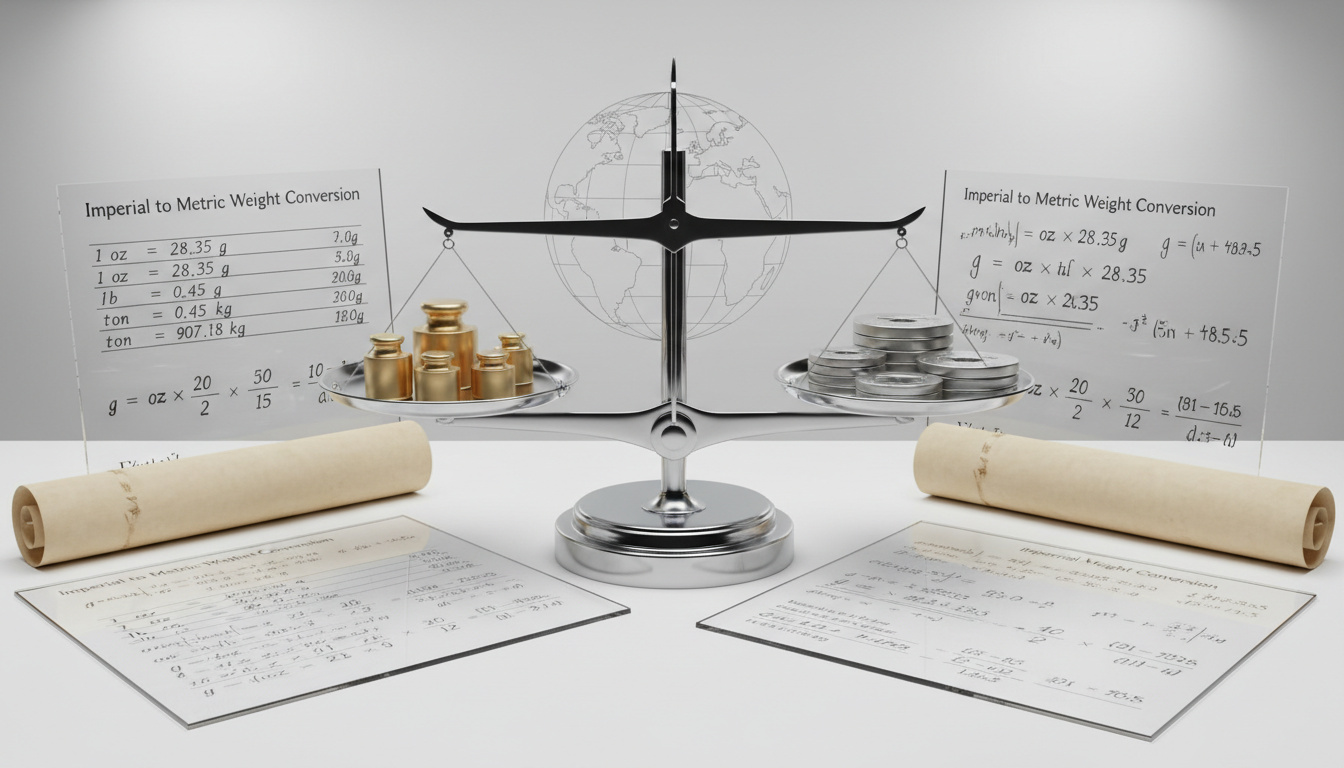

Converting ounces to grams demands attention to detail because the term “ounce” refers to two distinct measurement systems. While the avoirdupois ounce serves as the standard for everyday weight in cooking and shipping, the troy ounce governs international precious metals markets. Each system yields a different gram equivalent, creating significant discrepancies for anyone calculating material value or recipe proportions.
Understanding these distinctions prevents costly errors. A troy ounce weighs approximately 9.7 percent more than its avoirdupois counterpart, translating to a difference of nearly 2.75 grams per unit. This variation, rooted in medieval trading practices, continues to influence modern commerce from kitchen scales to gold bullion exchanges.
How Many Grams Are in an Ounce?
- The avoirdupois ounce equals exactly 28.349523125 grams under international standards.
- Troy ounces contain 480 grains compared to 437.5 grains in avoirdupois ounces.
- A troy pound contains only 12 ounces and weighs 373.242 grams, while an avoirdupois pound contains 16 ounces and weighs 453.592 grams.
- The grain has been precisely defined as 64.79891 milligrams since the 1959 international yard and pound agreement.
- European Union directive 80/181/EEC permits 31.10 grams as a sufficient approximation for troy ounce trading purposes.
- Cooking applications universally employ the avoirdupois system, making 28.35 grams the practical standard for culinary conversions.
- Gold and silver markets exclusively recognize the troy ounce, rendering the avoirdupois system invalid for precious metal transactions.
| Ounces (Avoirdupois) | Grams (Precise) | Grams (Rounded) |
|---|---|---|
| 1 oz | 28.3495 g | 28.35 g |
| 2 oz | 56.6990 g | 56.70 g |
| 3 oz | 85.0485 g | 85.05 g |
| 4 oz | 113.3980 g | 113.40 g |
| 5 oz | 141.7475 g | 141.75 g |
| 10 oz | 283.4950 g | 283.50 g |
How to Convert Ounces to Grams
The Avoirdupois Formula
For everyday conversions involving food, postal items, or household objects, multiply the ounce value by 28.3495. This factor derives from the international definition of the pound as exactly 453.59237 grams divided by 16 ounces. Online calculators automate this multiplication for larger datasets.
Troy Ounce Calculations
Precious metals require the troy multiplier of 31.1034768. This exact value results from 480 grains multiplied by 0.06479891 grams per grain, as established by the 1959 international agreement. Metrological standards recognize this calculation for bullion trading.
Scientific applications demand the full avoirdupois value of 28.349523125 grams. For culinary purposes, rounding to 28.35 grams introduces negligible error while simplifying mental arithmetic.
Ounces to Grams Conversion Chart
Comprehensive reference tables eliminate calculation errors for common weights. The following chart covers standard cooking measurements and small precious metal quantities.
| Avoirdupois Ounces | Grams | Troy Ounces | Grams |
|---|---|---|---|
| 0.5 oz | 14.17 g | 0.5 oz t | 15.55 g |
| 1 oz | 28.35 g | 1 oz t | 31.10 g |
| 2 oz | 56.70 g | 2 oz t | 62.21 g |
| 4 oz | 113.40 g | 5 oz t | 155.52 g |
| 8 oz | 226.80 g | 10 oz t | 311.03 g |
| 16 oz (1 lb) | 453.59 g | 12 oz t (1 lb t) | 373.24 g |
Troy Ounce vs Avoirdupois Ounce: Key Differences
Structural Variations
The avoirdupois system, developed for general commerce, divides the pound into 16 ounces. Each avoirdupois ounce contains 437.5 grains. Conversely, the troy system, originating from the Roman monetary system, maintains 12 ounces per pound with each ounce comprising 480 grains. Metals refining authorities note this structural difference creates pounds of significantly different weights.
Legal Recognition and Trade Standards
The United Kingdom’s Weights and Measures Act of 1985 legally recognizes the troy ounce exclusively for precious metals. Similarly, London precious metals markets operate strictly within the troy system. These regulations ensure standardized pricing for gold, silver, platinum, and palladium across international exchanges.
A troy pound weighs only 373.242 grams compared to 453.592 grams for an avoirdupois pound. Using the wrong system when pricing precious metals results in a 17.6 percent valuation error.
The modern grain weight of 64.79891 milligrams was fixed on July 1, 1959, under the international yard and pound agreement, enabling the exact troy ounce calculation used today.
The 1959 Agreement: Standardizing Modern Weights
- : The international yard and pound agreement establishes the grain as precisely 64.79891 milligrams, enabling exact troy ounce calculations of 31.10347680 grams.
- : The UK Weights and Measures Act legally mandates troy ounces exclusively for precious metal trading, formally separating everyday and commodity weight systems.
- : European Union directive 80/181/EEC establishes 31.10 grams as an acceptable trading approximation for the troy ounce within member states.
Established Facts vs. Remaining Questions
| Established Standards | Uncertainties or Variations |
|---|---|
| Avoirdupois ounce equals 28.349523125 grams exactly | Fluid ounce conversions require separate volume-to-mass calculations not covered by standard weight tables |
| Troy ounce equals 31.1034768 grams exactly | Pre-1959 historical ounce variations varied by region and merchant |
| Grain defined as 64.79891 milligrams since July 1, 1959 | Apothecaries’ ounce (obsolete) used different standards in some jurisdictions |
| UK law mandates troy for precious metals only | Non-standard “ounce” definitions persist in specialized industrial contexts |
Why Different Ounce Systems Persist
Medieval trade practices created specialized measurement systems for different commodities. Merchants handling Lab Grown Diamonds – 2025 Comparison, Prices and Facts and precious metals required precision down to the grain, leading to the troy system’s 480-grain ounce. General goods traders favored the avoirdupois system’s hexadecimal divisions for easier calculation.
Modern standardization has not eliminated these parallel systems because commodity markets depend on historical continuity. Changing the troy ounce would invalidate centuries of pricing data and existing contracts. Similarly, What Is Bitcoin – Simple Beginner’s Guide illustrates how digital commodities also require standardized units to maintain market stability, though unlike physical ounces, these remain purely mathematical constructs.
Sources and Technical References
“The exact troy ounce value can be calculated as: 480 grains × 0.06479891 grams/grain = 31.10347680 grams”
— International Yard and Pound Agreement Standards
For more information on converting units, check out this helpful guide to kilograms to stones and pounds. kilograms to stones and pounds
“Troy pounds are lighter than avoirdupois pounds because they contain only 12 ounces instead of 16.”
— Metals Refining Technical Documentation
For further metrological standards, consult NIST Weights and Measures and the International Bureau of Weights and Measures.
Summary
Precise ounce-to-gram conversion requires identifying whether the avoirdupois or troy system applies. Multiply avoirdupois ounces by 28.3495 for everyday applications, or by 31.1035 for precious metals. Remember that What Is Bitcoin – Simple Beginner’s Guide demonstrates how modern markets rely on standardized units for valuation accuracy, just as physical commodities depend on the distinction between these ancient measurement systems.
Common Questions
How many grams are in 2 ounces?
Two avoirdupois ounces equal 56.699 grams precisely, or 56.70 grams when rounded to two decimal places.
Is 28 grams exactly equal to 1 ounce?
No. One avoirdupois ounce equals 28.3495 grams. The 28-gram figure represents a rounded approximation suitable for rough estimates only.
How do I convert grams back to ounces?
Divide the gram value by 28.3495 for avoirdupois, or by 31.1035 for troy ounces. For example, 100 grams equals approximately 3.527 avoirdupois ounces.
Why do gold prices use troy ounces instead of grams?
International precious metals markets standardized on troy ounces centuries ago. The UK Weights and Measures Act of 1985 legally mandates this unit for gold, silver, platinum, and palladium trading.
Can I use a kitchen scale to weigh gold in troy ounces?
Standard kitchen scales measure in avoirdupois ounces. To measure troy ounces accurately, you need a scale calibrated specifically for the troy system or one that displays grams for manual conversion.
What is the difference between a troy pound and an avoirdupois pound?
A troy pound contains 12 troy ounces and weighs 373.242 grams. An avoirdupois pound contains 16 avoirdupois ounces and weighs 453.592 grams.
Are fluid ounces converted to grams the same way?
No. Fluid ounces measure volume, not mass. Converting fluid ounces to grams requires knowing the liquid’s density, as different substances have different weights per unit volume.

Maya Sharma is Managing Editor at Reef Brief, overseeing daily newsroom workflow, commissioning and headline review.