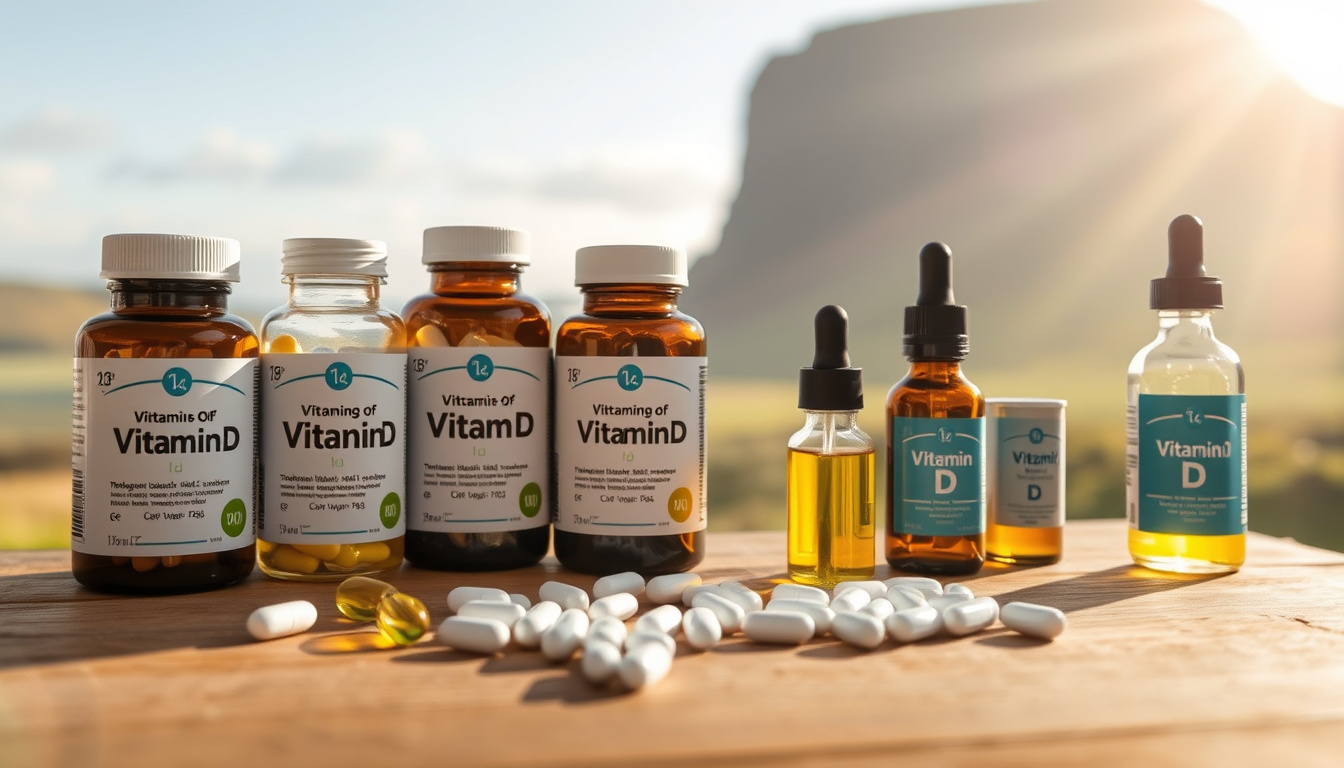
If you’ve spent any time in an Irish November—you know the one, grey skies from Cork to Donegal—you’ve probably heard someone mention vitamin D. It’s not hype: Ireland sits far enough north that winter sunlight simply doesn’t carry enough UVB to keep most people’s levels up. The good news is that supplementing is straightforward, provided you know the right dose and who’s most at risk. This guide lays out the official Irish guidance so you can figure out what applies to you or your family.
Recommended daily dose (Ireland): 15 micrograms · Prevents in children: rickets · Prevents in adults: osteomalacia · Supports: immune system normal function · Top sources: supplements year-round
Quick snapshot
- HSE recommends 15 micrograms daily for everyone in Ireland (HSE Ireland)
- FSAI sets adult upper limit at 100 micrograms (4,000 IU) per day (FSAI News)
- Over 90% of the Irish population does not meet the recommended daily vitamin D allowance (PubMed Review)
- Exact toxicity threshold varies by individual
- Long-term population data post-2023 limited
- Personalised dosing based on genetic factors not yet standard
- FSAI published vitamin D report for ages 5-65 (pre-2026)
- PubMed review on Irish intake/status published June 2023
- Guidelines continue to evolve based on EFSA and SACN references from 2016
- HSE continues ongoing updates to vitamin D guidance
- Healthcare providers increasingly screen at-risk groups
- Public awareness campaigns may expand testing access
| Category | Details |
|---|---|
| Daily recommendation (HSE) | 15 micrograms all year |
| Helps regulate | Calcium and phosphorus |
| Deficiency risks | Rickets, osteomalacia |
| Sources | Sunlight, fortified foods, supplements |
What is the best form of vitamin D to take?
Vitamin D supplements come in two main forms: D2 (ergocalciferol) and D3 (cholecalciferol). D3 is generally considered the more effective option for raising and maintaining vitamin D levels in the blood. Both are available in tablets, capsules, and drops across Irish pharmacies and retailers.
Vitamin D2 vs D3
Research from the UK’s National Health Service guidance indicates that vitamin D3 tends to raise blood levels of 25-hydroxyvitamin D more effectively than D2. The Probiotic.ie supplement analysis notes that most Irish supplement retailers stock D3 as the standard option. If you’re choosing between the two, D3 is the more evidence-backed choice for daily supplementation.
Vitamin D3 supplements are widely available in Boots, Dunnes, and pharmacies across Ireland. D3 raises blood levels more effectively than D2, making it the preferred choice for most people.
Absorption rates
The HSE official vitamin D guidance recommends taking your supplement with a meal, as vitamin D is fat-soluble and absorbs better alongside dietary fat. Capsules and tablets work equally well for most adults; drops are often preferred for infants and young children.
Upsides
- D3 is the most studied and effective supplemental form
- Taken with food, absorption is reliable
- Available over the counter in standard 15 µg doses
- Both tablet and liquid formats suit different preferences
Downsides
- Not all products are tested for purity independently
- Higher-dose supplements (e.g., 5,000 IU) can exceed the FSAI upper limit
- Formulation quality varies between brands
The pattern: most standard over-the-counter products in Ireland are formulated to meet the 15 µg HSE recommendation. High-strength options exist but are better suited to cases where a GP has identified a deficiency and prescribed a loading dose.
What are the signs you need vitamin D?
Vitamin D deficiency doesn’t always announce itself loudly, which is part of why it goes undiagnosed so often. That said, certain symptoms and risk profiles should prompt you to consider supplementation—or a blood test.
Common deficiency symptoms
According to the HSE public vitamin D guidance and research summarised in a PubMed narrative review on Irish vitamin D intake, common signs include persistent fatigue, bone pain, muscle weakness, and frequent infections. In children, deficiency can lead to rickets—a condition involving soft, weak bones. In adults, osteomalacia (softening of bones) is the adult equivalent.
A 2023 PubMed review found that 13% of Irish adults had deficiency levels (25(OH)D below 30 nmol/L), with pregnant women and children showing rates of 15-23%. These numbers are substantial enough that you shouldn’t dismiss vague symptoms.
When to test levels
Testing isn’t routine for everyone, but the FSAI vitamin D report identifies high-risk groups: pregnant women, teenagers, people with dark skin, and those who spend most of their time indoors. If you fall into one of these categories, a chat with your GP about testing is worthwhile. A simple blood test measuring 25-hydroxyvitamin D can confirm whether your levels are adequate.
Ireland’s latitude means winter sunlight alone cannot sustain vitamin D levels for most people. The HSE states that everyone in Ireland is at risk of deficiency in winter. Waiting for symptoms to appear may mean you’ve already been deficient for months.
What this means: if you’re tired all the time and can’t quite explain it, low vitamin D is a plausible culprit—especially in winter. A test costs less than ignoring the problem and dealing with bone health issues later.
Is it healthy to take vitamin D daily?
Yes, for most people, taking a daily vitamin D supplement is not only safe but recommended by Irish health authorities. The key is sticking to the advised dose and knowing your upper limit.
Daily intake recommendations
The HSE recommends 15 micrograms (600 IU) of vitamin D every day, all year round, for everyone in Ireland. This figure is notably higher than the UK’s 10 microgram recommendation from NHS vitamin D guidance, reflecting Ireland’s higher latitude and lower average sunlight exposure.
The FSAI vitamin D report for ages 5-65 sets the upper tolerable intake level (UL) at 50 micrograms for children and 100 micrograms for adults. According to the Probiotic.ie dosage guide, 1 microgram equals 40 IU. This means 100 micrograms equals 4,000 IU—the adult upper limit.
Safety for long-term use
The FSAI states that “the recommended daily dose of 10 µg or 15 µg for children and adults, respectively, is overall a safe level of supplemental vitamin D.” The authority also urges the public “to be mindful of the daily recommended dose and not to exceed this unless advised by a medical professional.” Long-term excessive intake—primarily from supplements, not sunlight—is what causes vitamin D toxicity, which is rare but serious.
“We urge the population to be mindful of the daily recommended dose and not to exceed this unless advised by a medical professional.”
— FSAI (Food Safety Authority of Ireland), official report
The catch: supplements are the culprit in virtually all cases of vitamin D toxicity. You cannot overdose from sunlight—your body simply stops producing vitamin D once levels are sufficient. Stick to the daily 15 µg dose, and don’t pile on high-dose products “just in case.”
Is it okay to take 1000 IU of vitamin D every day?
1,000 IU equals 25 micrograms. This falls well below the FSAI’s upper limit of 100 micrograms (4,000 IU) for adults and is considered generally safe. However, it’s below the HSE’s recommended 15 micrograms (600 IU) daily, so you may not be getting enough if that’s your sole source.
Dosage comparisons
Here’s how common doses stack up against Irish recommendations:
| Product strength | IU equivalent | Meets HSE recommendation? | Within adult UL? |
|---|---|---|---|
| 5 µg drops (infants) | 200 IU | For babies only | Yes |
| 10 µg | 400 IU | Below adult target | Yes |
| 15 µg (600 IU) | 600 IU | Yes (adult target) | Yes |
| 25 µg (1,000 IU) | 1,000 IU | Below adult target | Yes |
| 100 µg (4,000 IU) | 4,000 IU | Well above target | At adult UL |
| 125 µg (5,000 IU) | 5,000 IU | Well above target | Exceeds adult UL |
The implication: 1,000 IU (25 µg) is safe and stays comfortably within the adult upper limit, but it falls short of the 15 µg that HSE recommends for most Irish adults. If you’re relying solely on this dose, you may not be reaching the target needed for optimal bone health through an Irish winter.
The FSAI older adults vitamin D report notes that 5,000 IU (125 µg) exceeds the adult upper limit of 100 micrograms. Products sold at this strength should only be used under medical supervision.
Upper limits
The FSAI’s upper limits, based on EFSA’s 2016 assessments, are:
- Children (5-65 years): 50 micrograms (2,000 IU) daily
- Adults (18+): 100 micrograms (4,000 IU) daily
- Older adults (65+): varies by mobility—10 µg October to March for independent adults with sun exposure; 15-20 µg daily for housebound individuals
What happens if I take vitamin D if I don’t need it?
If you’re already getting enough vitamin D from sunlight and diet, adding a standard daily supplement at 15 µg is unlikely to cause problems. Your body will use what it needs and simply excrete the rest. Problems arise only with sustained high-dose supplementation.
Risk of toxicity
True vitamin D toxicity (hypervitaminosis D) occurs when blood levels become dangerously high, typically from ingesting far more than the upper limit for weeks or months. According to Probiotic.ie toxicity analysis, “long-term excessive vitamin D intake can cause toxicity, primarily from supplements.” Symptoms include nausea, vomiting, weakness, confusion, and in severe cases, kidney problems.
At the standard 15 µg daily dose, toxicity is essentially impossible—you’d need to take roughly 6-7 times the upper limit consistently to approach danger levels. As the FSAI puts it: the recommended daily dose is a safe level of supplemental vitamin D.
Overdose symptoms
If you’ve been taking unusually high doses and experience persistent nausea, loss of appetite, excessive thirst, frequent urination, or constipation, speak to a pharmacist or GP. A blood test can confirm whether your calcium levels are elevated.
Taking 5,000 IU (125 µg) supplements daily without medical oversight is not a benign choice—it’s 25% above the adult upper limit set by FSAI. If you’re buying high-strength products online or in pharmacies, check the label against the 100 µg (4,000 IU) daily ceiling for adults.
Why this matters: most Irish adults aren’t getting enough vitamin D in the first place. The PubMed review reports that mean intake in older adults is just 6.9 µg/d, well below the 15 µg target. For the vast majority, the real risk isn’t overdose—it’s deficiency.
Vitamin D supplements compared
Irish retailers stock vitamin D supplements in various formats and strengths. Here is how the main options compare based on available guidance from HSE, NHS, and FSAI.
| Form | Typical dose | Best for | Irish availability | Meets HSE target? |
|---|---|---|---|---|
| Tablets / capsules | 10–15 µg | Adults, consistent dosing | Boots, Dunnes, pharmacies | Yes (15 µg tablets) |
| Liquid drops | 5 µg per drop | Infants, young children | Pharmacies, health stores | Yes (5 µg for babies) |
| Chewable tablets | 10–15 µg | Children who can’t swallow pills | Pharmacies | Yes |
| High-strength (5,000 IU) | 125 µg | Prescription or GP-advised only | Limited, online | No (exceeds UL) |
| Vitamin D + calcium | 10–15 µg D + calcium | Older adults, bone health | Pharmacies | Yes (combo products) |
The pattern: most standard over-the-counter products in Ireland are formulated to meet the 15 µg HSE recommendation. High-strength options exist but are better suited to cases where a GP has identified a deficiency and prescribed a loading dose.
Recommended specifications by age group
Vitamin D needs aren’t identical across the lifespan. The FSAI, HSE, and Children’s Health Ireland provide specific guidance by age and risk group.
| Group | Recommended dose | When to take | Source |
|---|---|---|---|
| Babies (under 12 months, breastfed/low formula) | 5 µg daily | All year | HSE / Children’s Health Ireland |
| Children (1-4 years) | 5 µg daily | October to March | HSE |
| Children (5-17 years) | 10 µg daily | Year-round recommended | FSAI |
| Adults (18-65) | 15 µg daily | Year-round | FSAI / HSE |
| Older adults (independent, with summer sun) | 10 µg daily | October to March | FSAI |
| Older adults (independent, no summer sun) | 15 µg daily | Year-round | FSAI |
| Older adults (housebound) | 20 µg daily | Year-round | FSAI |
| Pregnant women | 10 µg daily | Year-round | HSE |
The implication: infants and pregnant women sit at the lower end of recommendations, while housebound older adults need the highest daily dose. Most Irish adults fall in the 15 µg year-round category. If you’re over 65 and spend most of your time indoors, talk to your GP about whether you should be on the 20 µg regimen instead.
Related reading: Snap Fitness Ireland Locations and Memberships
fsai.ie, shropshiretelfordandwrekinccg.nhs.uk, impendo.co.uk, swlimo.southwestlondon.icb.nhs.uk, ods.od.nih.gov, imj.ie
While HSE advises 15 mcg of vitamin D daily year-round in Ireland, the Vitamin D3 RDA chart details safe dosages and limits for various needs.
FAQ
How much vitamin D per day Ireland?
The HSE recommends 15 micrograms (600 IU) daily for everyone in Ireland, all year round. Children aged 1-4 should take 5 micrograms from October to March. Older housebound adults may need 20 micrograms daily.
What are vitamin D supplements benefits?
Vitamin D supports normal calcium and phosphorus absorption (essential for bone health), muscle function, and immune system normal function. In children, it helps prevent rickets. In adults, it helps prevent osteomalacia.
What drink is high in vitamin D?
Fortified plant milks, oat milks, and some dairy alternatives are increasingly fortified with vitamin D in Ireland. Cow’s milk is not naturally high in vitamin D but fortified versions are available. For reliable dosing, supplements remain the most consistent source.
Best vitamin D supplement Ireland?
Look for a supplement providing exactly 15 micrograms (600 IU) of vitamin D3 per tablet or capsule—available at Boots, Dunnes, and most pharmacies. D3 form is preferred over D2. Liquid drops at 5 µg per drop suit infants.
Vitamin D supplements dose?
Standard daily doses in Ireland are: 5 µg for babies, 10 µg for children 5-17 years, 15 µg for most adults, and up to 20 µg for housebound older adults. Upper limits are 50 µg for children and 100 µg (4,000 IU) for adults per day.
What happens when your vitamin D is low?
Low vitamin D levels can cause fatigue, bone pain, muscle weakness, and frequent infections. In children, it may lead to rickets. In adults, prolonged deficiency can cause osteomalacia (softening of bones). A blood test measuring 25-hydroxyvitamin D can confirm deficiency.
Vitamin D prescription tablets?
Standard vitamin D supplements are available over the counter in pharmacies and retailers. High-dose or prescription-strength vitamin D is prescribed by GPs for confirmed deficiency requiring loading doses. Standard 15 µg supplements do not require a prescription.
For Irish adults, the bottom line on vitamin D supplementation is straightforward: most people in Ireland are deficient, and the solution is a daily 15 µg supplement taken year-round. Babies need 5 µg; children need 10 µg; housebound older adults may need up to 20 µg. The standard over-the-counter 15 µg D3 tablet covers the majority of the population. Avoid products at 5,000 IU (125 µg) unless your GP specifically prescribed that dose—it’s above the FSAI’s adult upper limit. For infants, drops are the practical choice. For everyone else, a simple tablet or capsule taken with a meal is all it takes to protect bone health and support normal immune function through an Irish winter.

Priya Tran leads fact-checking, source verification and corrections at Reef Brief.