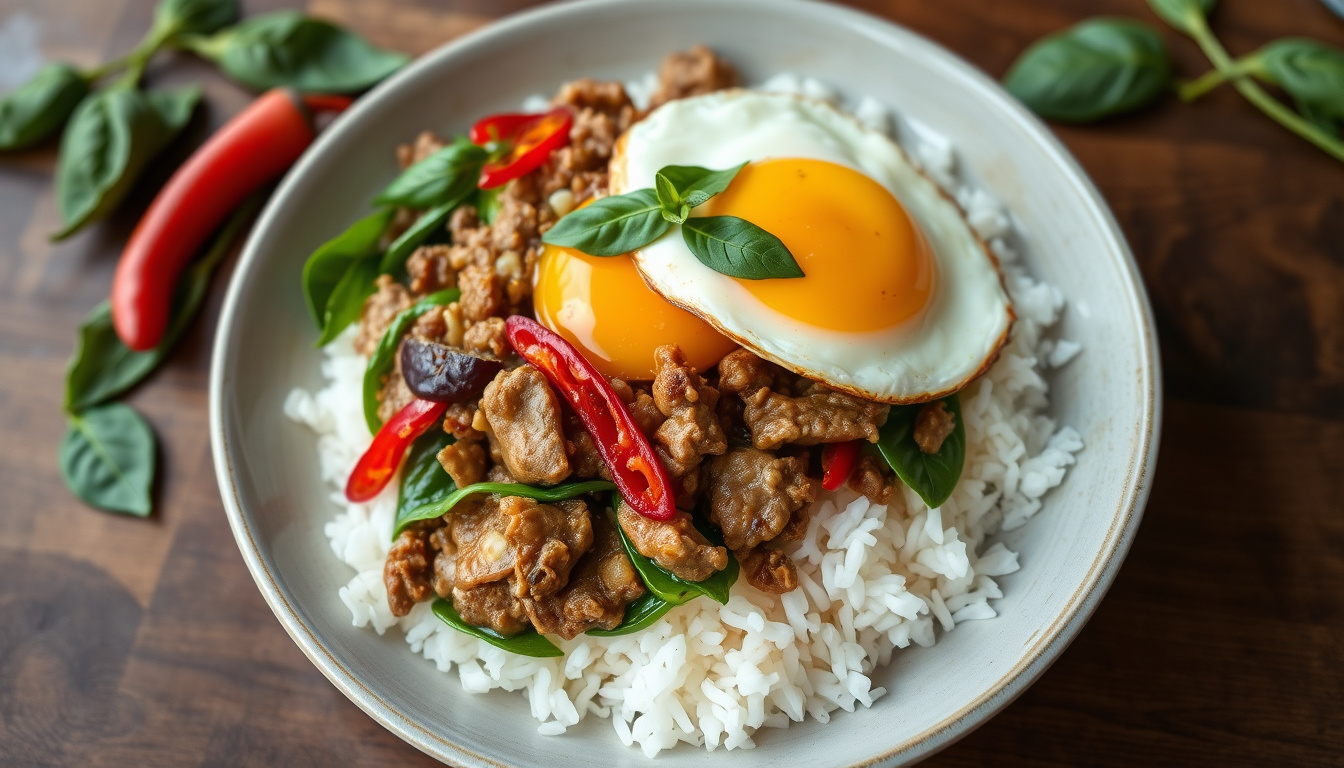
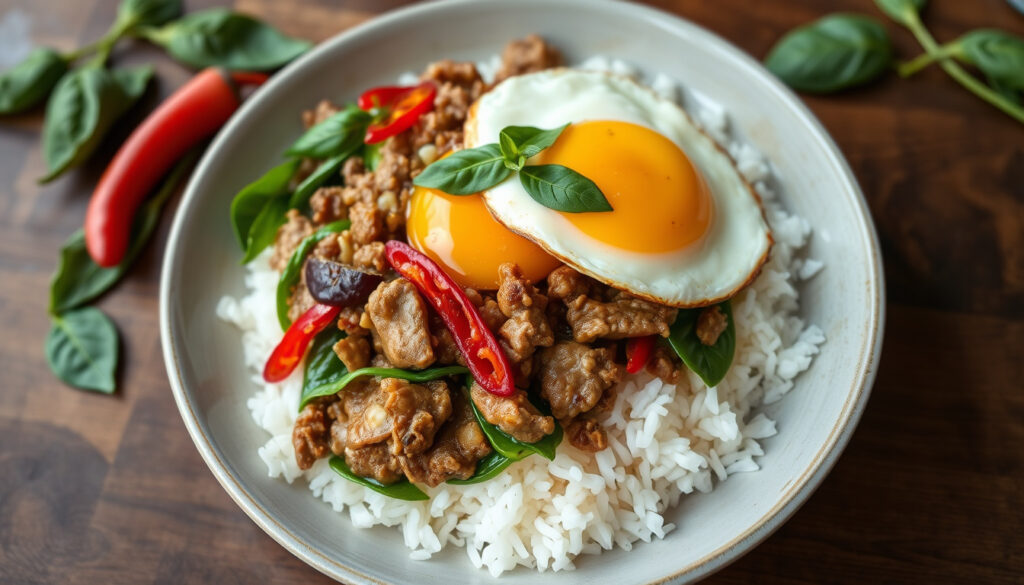
Anyone who’s wandered through Bangkok’s night markets knows that smell — the sharp hit of peppery basil mingling with garlic and chilies sizzling in a hot wok. That’s pad kra pao, and it hits different when it’s made the way the street vendors have been doing it since the 1950s.
Origin: Thailand · Key Ingredient: Holy Basil · Typical Protein: Chicken, Pork or Beef · Avg. Calories: 400 per serving · Prep + Cook: Under 20 minutes
Quick snapshot
- Uses holy basil — not sweet basil — for its peppery, clove-like flavor (Well Seasoned Studio)
- Chicken, pork, and beef are the go-to proteins (Hot Thai Kitchen)
- Typically served over jasmine rice with a fried egg on top (Shef)
- Exact calorie count varies by portion and protein choice
- Regional Isaan vs Bangkok style distinctions lack detailed documentation
- Mid-1900s: emerges from street vendors on carts (Shef)
- 21st century: spreads to Thai restaurants worldwide (ThaiFex Anuga)
- Modern versions increasingly add vegetables like green beans and onions (Hot Thai Kitchen Newsletter)
- Innovative proteins including century eggs appearing in contemporary Thai versions (Hot Thai Kitchen Newsletter)
The key facts table below captures the dish’s essential profile at a glance.
| Label | Value |
|---|---|
| English Name | Holy Basil Stir-Fry |
| Thai Script | ผัดกะเพรา |
| Main Herb | Holy Basil (not sweet basil) |
| Avg. Calories | 400 per serving |
| Cook Time | 15 minutes |
What is pad kra pao?
Pad kra pao (also spelled pad krapow, pad gaprao, or pad ka prao) is a Thai stir-fry built around holy basil, chilies, garlic, and a protein of choice — most commonly chicken. It originated with mid-1900s Thai street vendors and has since become ubiquitous across the country, appearing on menus from Bangkok food courts to convenience store hot plates. Hot Thai Kitchen defines it as “a Thai holy basil stir-fry” that represents “spicy, savory, well-balanced” flavors at their best.
Origin and popularity in Thailand
According to Shef, pad kra pao traces its roots to Thai street vendors serving stir-fried dishes from carts starting in the 1950s. It quickly became a contender for Thailand’s national dish, with ThaiFex Anuga noting that the dish’s “role as a national staple is what truly cements it as the country’s ultimate comfort food, a status that easily surpasses the globally marketed Pad Thai.”
Common variations like chicken or beef
While pad kra pao gai (chicken) ranks as the most popular version, pork and beef are equally authentic options. Hot Thai Kitchen’s newsletter documents even more adventurous variations in contemporary Thailand, including deep-fried century eggs as protein.
This dish belongs to every Thai household, not just restaurants — that explains why it tastes different everywhere you try it, and why everyone thinks theirs is the real one.
What is pad krapow made of?
The classic version keeps it simple: ground meat, holy basil, chilies, and basic seasonings without vegetables. Modern restaurant versions often bulk it up with green beans, onions, oyster sauce, and dark soy sauce, but those additions are a departure from traditional street-food style, according to Hot Thai Kitchen’s recipe analysis.
Key ingredients list
Most authentic recipes call for 200–300g of ground or sliced chicken, 5 cloves of garlic, 5–10 Thai bird’s eye chilies, and 1 cup of loosely packed holy basil leaves. The sauce combo typically includes oyster sauce, fish sauce, dark soy sauce, and a pinch of sugar in roughly equal proportions. Eating Thai Food specifies “½ tsp light soy, splash dark sweet soy, ½ tsp sugar” for a cleaner flavor profile.
Holy basil role
Holy basil (kra pao) is the defining ingredient that separates this dish from every other stir-fry. Well Seasoned Studio describes its flavor as “peppery, clove-like with a slight anise aroma,” distinct from the sweeter notes of Thai basil or Italian basil. Hot Thai Kitchen notes that Italian basil actually substitutes better than Thai basil due to a more similar flavor profile — an important workaround for cooks outside Thailand where holy basil is hard to find.
Swapping in sweet basil won’t give you pad kra pao — it will give you something closer to pesto. Hunt for holy basil or use Italian basil as your backup.
Is pad kra pao spicy or not?
The default answer is yes — pad kra pao uses Thai bird’s eye chilies that bring genuine heat. But the spice level is one of the most adjustable things about the dish, and the flavor profile is surprisingly complex even when you tone down the chilies.
Spice level factors
Traditional recipes use 5–10 bird’s eye chilies per serving, which registers well above mild on most heat scales. The chilies are typically pounded with garlic into a paste before stir-frying, infusing the oil throughout the dish rather than delivering isolated heat pockets. Shef notes the dish represents “Thai cuisine: spicy, savory, well-balanced” — the balance part matters because fish sauce, sugar, and holy basil temper the burn.
Customization tips
Hot Thai Kitchen serves prik nam pla — a condiment of fish sauce, lime juice, extra chilies, and garlic — alongside the dish so each diner controls their own heat. At home, reducing chilies to 2–3 per serving gives you a more aromatic dish with just a warm finish. Mark Wiens of Eating Thai Food calls pad kra pao “the most popular, and the most beloved Thai street food dish of all time” — part of that appeal comes from how easy it is to make it your own.
Cutting chilies preserves the aroma but dulls the dish’s signature punch. For new cooks: start with fewer chilies and add prik nam pla at the table rather than cooking them blind.
Is pad kra pao a healthy dish?
Pad kra pao sits in a reasonable zone for a weeknight protein dish — roughly 400 calories per serving — but the nutritional picture shifts depending on your protein choice, sauce quantities, and whether you top it with a fried egg.
Nutrition breakdown
A standard serving with chicken provides solid protein (roughly 25–30g) from the meat itself. The holy basil contributes antioxidants and has traditional medicinal uses in Thai herbalism. Well Seasoned Studio notes the dish is “dairy-free,” which makes it friendlier for lactose-intolerant diners compared to cream-based weeknight alternatives.
Calories and benefits
The 400-calorie estimate assumes a single fried egg on top (kai dao) and a moderate amount of sauce. Adding extra oil, double egg, or heavier protein portions pushes that number higher. The upside is that the dish relies on fresh aromatics and herbs rather than processed ingredients — it’s real food with simple components.
Pad kra pao chicken recipe
This is the version most Thais default to at home. It draws from Hot Thai Kitchen, LeelaLicious, and Eating Thai Food for a realistic mix of technique and proportions. The Woks of Life records cooking times as “3 min prep, 7 min cook” — making this a legitimate 10-minute meal.
Authentic steps
- Pound garlic and Thai chilies in a mortar until coarse paste forms (or mince and mix).
- Heat wok over high heat with 2 tablespoons oil until smoking point.
- Add garlic-chili paste and fry 1–2 minutes until fragrant and golden.
- Add 200–300g ground or sliced chicken, break apart, cook 2–3 minutes until no longer pink.
- Add sauces: 1–2 tsp oyster sauce, 1–2 tsp fish sauce, 1–2 tsp dark soy sauce, 1–2 tsp sugar. Toss to coat.
- Add ½ cup long beans or diced onion if using; stir-fry 1 minute.
- Remove from heat, fold in 1 cup loosely packed holy basil leaves until wilted.
- Serve immediately over jasmine rice with a crispy fried egg (kai dao) on top.
Simple version shortcuts
No mortar? Use a food processor for the garlic-chili paste. No fresh holy basil? Hot Thai Kitchen confirms Italian basil works as a substitute. No wok? A cast-iron skillet over high heat produces acceptable results — the high heat and quick cook time matter more than the specific vessel.
Holy basil wilts in seconds — add it off the heat and fold gently. Cooking it further turns it black and bitter within 30 seconds.
Upsides
- Under 20 minutes from start to plate
- Five core ingredients, most pantry staples
- High protein, dairy-free, moderate calories
- Adaptable to any protein preference
- Authentic street-food flavor with basic equipment
Downsides
- Thai holy basil often unavailable outside major cities
- Bird’s eye chilies can overwhelm unfamiliar palates
- Wok-level heat difficult to replicate on home stoves
- Traditional recipe lacks vegetables for nutritional balance
- Sodium from fish and soy sauce adds up quickly
Related reading: Butter Chicken Sauce Recipe · Greek Salad Dressing Recipe
leelalicious.com, eatingthaifood.com, youtube.com, hot-thai-kitchen.com, uwajimaya.com
Pad kra pao highlights holy basil’s punchy aroma, a flavor profile echoed in the Thai-Lao dishes at Holy Basil Darling Square amid Sydney’s bustling food scene.
Frequently asked questions
Why is pad kra pao so good?
The combination hits multiple flavor buttons simultaneously — salty from fish sauce, sweet from sugar, numbing heat from chilies, and aromatic pepper from holy basil. Shef editors observe that “ask any Thai native to name a few of their favorite comfort food dishes, and pad kra pao will surely make the list” — and that appeal comes from its balance of bold flavor and quick satisfaction.
What is the English name for pad krapow?
It doesn’t have an official English name, but descriptive translations include “holy basil stir-fry,” “Thai basil chicken,” or “holy basil chicken.” The ThaiFex Anuga editorial refers to it as Thailand’s “national comfort food” — a title that says more than any single translation does.
What are pad kra pao ingredients?
Core ingredients: holy basil, Thai bird’s eye chilies, garlic, protein (chicken/pork/beef), oyster sauce, fish sauce, dark soy sauce, sugar. Optional add-ins: long beans, onions, prik nam pla condiment.
How to make authentic pad kra pao recipe?
Pound garlic and chilies into a paste, fry in hot oil until fragrant, add ground chicken and cook through, mix in sauces, optionally add vegetables, remove from heat and fold in fresh holy basil. Serve over jasmine rice with a crispy fried egg on top. Total time: under 20 minutes.
How many calories in a simple pad kra pao recipe?
Approximately 400 calories per serving with chicken and a single fried egg, based on standard ingredient proportions from multiple recipe sources. Sauce quantity and protein portion size are the biggest variables.
Can pad kra pao be made with beef?
Absolutely — beef pad kra pao (pad krapow neua) is a standard variation in Thailand. Hot Thai Kitchen publishes a dedicated beef version, and the cooking method remains identical regardless of protein choice.
What makes pad kra pao chicken flavorful?
Three factors: the holy basil’s peppery aroma, the fermented-savory depth from fish and oyster sauce, and the fresh heat from bird’s eye chilies fried into the oil. Pailin of Hot Thai Kitchen calls it “a Thai holy basil stir-fry that deserves the title: National dish of Thailand.”
“It’s a favourite of Thai people and Thai food lovers around the world, and if you’re getting into Thai cooking, this pad kra pao is a Thai holy basil stir fry that I think deserves the title: ‘National dish of Thailand’.”
— Pailin, Hot Thai Kitchen
“Ask any Thai native to name a few of their favorite comfort food dishes, and pad kra pao will surely make the list.”
— Shef Editors
“Thai basil chicken, better known in Thai as pad kra pao gai, is a contender for the most popular, and the most beloved Thai street food dish of all time.”
— Mark Wiens, Eating Thai Food
For home cooks in North America or Europe, the main barrier is sourcing holy basil — once you solve that, the dish comes together in under 20 minutes with ingredients that keep for weeks. Those who master it gain a reliable weeknight dinner that tastes more authentic than most restaurant versions. Those who skip the holy basil in favor of convenience store Thai basil will get something edible but fundamentally different — closer to a Thai-inspired pasta than the real article.

Priya Tran leads fact-checking, source verification and corrections at Reef Brief.