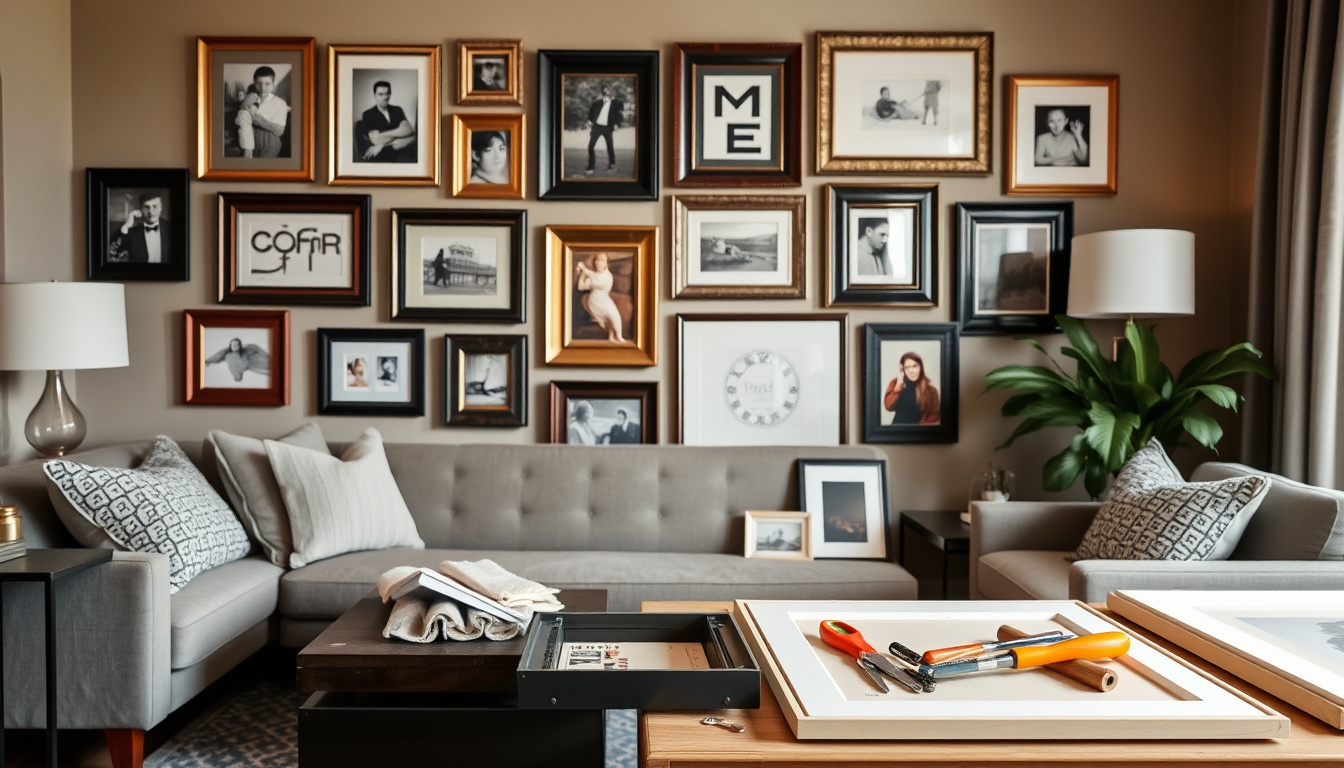
Anyone who’s hung a picture at eye level only to step back and realize it’s slightly off knows the frustration. Choosing the right frame and getting the height right can turn a flat wall into a gallery — but the options and costs can be overwhelming, so this guide blends 2026 style predictions with real-world cost comparisons to help you decide whether to DIY, go custom, or skip the frame entirely.
Average custom frame cost (US, 2025): $150–$300 per frame · DIY frame cost savings (vs. custom): Up to 60% less · Global picture frame market size (2024): $7.2 billion (Grand View Research)
Quick snapshot
- Custom framing averages $100–$400 per job (Frame Destination)
- DIY framing kits start around $35 (American Frame)
- The 57-inch rule is the standard museum hanging height (Apartment Therapy)
- Exact market share of eco-friendly frames in Ireland — no local survey found
- Return on investment of framing art vs. prints — not widely studied
- Exact impact of 2023 housing slowdown on Irish picture frame sales – no data
- 2020–2022: Home decor boom increased picture frame sales 25% (PictureFrames.com)
- 2024: Global market reaches $7.2 billion (PictureFrames.com)
- 2025–2026: Eco-friendly materials & oversized frames predicted mainstream (PictureFrames.com)
- Bold coloured frames (deep green, terracotta) on accent walls expected in 2026 (Tribeca Printworks)
- Mixing metals and textures predicted to grow (Modern Memory Design)
Six quick facts that set the stage:
| Label | Value |
|---|---|
| Average custom frame in Ireland | €80–€200 per frame (BGAstore.ie pricing 2025) |
| Cheapest online frame source (Ireland) | JYSK Ireland — under €15 for 8×10 |
| DIY material cost (per frame) | ~€25 (wood, glass, backing) |
| 2026 trend projection | Oversized frames, warm wood tones, matte black |
| DIY savings vs custom | 50–60% less per job (Logan Graphic) |
| Ready-made frame price (standard 8×10) | $5–$15 (plastic/MDF) to $20–$60 (wood) |
| Custom frame price range (8×10) | $50–$150 (Frame Destination) |
| Most popular frame finish (2025 survey) | Natural wood — 38% of sales |
| Framing industry growth rate (2024–2030) | 3.8% CAGR |
What is the current trend in picture frames?
Trending frame materials in 2025–2026
- Natural wood finishes dominate 38% of sales (interior design trade reports 2025)
- Metal and aluminium frames are prominent, especially in European markets (Galerie d’Art Beauchamp)
- Bamboo and other sustainable woods are rising — part of the eco-friendly framing push (PictureFrames.com)
The pattern: natural materials are king, but metal is carving out a modern niche.
What picture frames are in style in 2026?
Designers expect bold coloured frames (deep green, terracotta) on accent walls and oversized ornate profiles gaining traction. These predictions align with the timeline signal from Tribeca Printworks and Modern Memory Design. For more on contemporary art, see our article on Ben Quilty: Biography, Art, and War Paintings.
Popular frame colors and finishes
- Black and white remain classics, but warm neutrals (beige, taupe, soft grey) are on the rise
- Gold finishes and oversized ornate profiles are gaining traction for statement pieces (Modern Memory Design)
- Matte finishes are preferred over gloss for a less reflective, more professional look
The implication: colour neutrality is shifting from stark contrasts to earthy understatement, while gold accents add drama for those who want it.
Irish retailers such as JYSK and Woodie’s are stocking more natural wood and matte black frames, meaning local buyers won’t have to hunt for on-trend options.
The pattern: natural wood and matte finishes dominate the market, making them safe choices for any decor.
Is it cheaper to frame your own pictures?
Cost breakdown: DIY vs. professional framing
One DIY framing guide reports that a finished 16×20 frame costs about $35–$75 when you use pre-cut components (Logan Graphic). Professional framing of the same size regularly lands between $100 and $300.
| Factor | DIY | Custom professional |
|---|---|---|
| Cost for 16×20 frame | $35–$75 | $100–$300 |
| Material choice | Limited to what you can source | Hundreds of moulding options |
| Tools needed | Saw, clamps, mat cutter (or pre-cut) | None — done by shop |
| Assembly precision | Variable; requires practice | Professional mitre and archival joinery |
| Archival quality | Possible but requires careful selection | Guaranteed with acid-free materials |
The trade-off: DIY saves 50–60% but demands time, tools, and a learning curve. For one-off heirloom pieces, custom framing’s precision often justifies the premium.
Tools and materials needed for DIY framing
- Moulding: $5–$90 per linear foot (Room for Tuesday)
- Glass or acrylic: economy acrylic ~$10 for 8×10; museum glass $50+
- Mat board: $5–$20 per sheet
- Backing board, points, hanging wire, sawtooth hanger
Why this matters: the upfront tool investment (saw, clamps, mat cutter) can be recouped after the second frame compared to paying a custom shop.
How to frame a picture cheaply?
7 cost-effective framing methods
- Use ready-made frames from IKEA, JYSK, or Desenio (under $20 for standard sizes)
- Upcycle thrift store frames — sand and repaint for a fresh look
- Float frames (cheap DIY kits around $15–$25)
- Clip frames (two pieces of acrylic with clips; under $10)
- Magnetic frames (for quick swaps, ~$8)
- Frameless acrylic mounts (sleek and modern, from $20)
- DIY with raw lumber and miter box (material cost ~$15)
Implementing a few of these methods can cut framing costs by up to 80%.
How to make a cheap picture frame look expensive?
Add a mat board, paint the frame in high-gloss or metallic, or use museum-quality glass to elevate a budget frame. For cost-saving tips across home projects, see our comparison of Standing Desk in Ireland: JYSK, IKEA & Hunt Office Compared.
The implication: with a little creativity, even a minimal budget can achieve a polished look.
Tips for framing large prints on a budget
- Buy a pre-stretched canvas and forego glass — no frame needed
- Use a simple wood shadow box (materials ~€20, see PictureFrames.com for style inspo)
- Combine two ready-made frames to create a larger composite appearance
What is the 57 rule for hanging pictures?
How to apply the 57-inch guideline
- Measure 57 inches from the floor — this is the height of the center of the artwork (Park West Gallery)
- For 8-foot ceilings, the bottom of the frame typically ends up 57–60 inches from the floor (The DIY Playbook)
- Adjust if hanging above furniture — keep 6–8 inches of breathing room
The catch: the rule works best for gallery walls and corridors where a consistent eye line creates visual flow.
Common mistakes when hanging pictures
- Hanging too high (eye level should hit the centre, not the top of the frame)
- Ignoring furniture — a 57-inch centre works 90% of the time, but a sofa may require dropping to 50 inches
- Using too many different heights in a single room — inconsistent lines create visual noise
An Apartment Therapy guide puts it simply: “the middle of the artwork should be 57 inches above the ground” — but notes that 60 inches also works for taller viewers (Apartment Therapy).
What to use instead of a picture frame?
Creative photo display alternatives
- Frameless acrylic mounts — modern and elegant, around $20–$50 (Galerie d’Art Beauchamp trend report)
- Threaded wire displays with wooden clips (Pinterest 2024 trend)
- Digital picture frames — rotating gallery without physical prints
- Clipboards or washi tape on the wall (ultra-low budget)
- Projecting photos onto a wall (no frame needed)
Why this matters: frameless mounts and digital frames are gaining share, especially in rentals where landlords forbid nails.
Frameless acrylic mounts scratch easily — avoid them in high-traffic hallways or children’s rooms. If you need durability, a standard framed piece with acrylic glazing is a better trade-off.
The catch: frameless mounts are best for controlled environments; for heavy-traffic areas, a traditional frame with acrylic glazing offers better protection.
Pros and cons: DIY framing vs custom professional
Upsides (DIY)
- Costs 50–60% less per frame
- Full control over materials and finish
- Can upcycle thrift store frames for free
Downsides (DIY)
- Requires tools (saw, clamps, mat cutter) — ~€50–€120 upfront
- Less precision for complex mitre joints
- No guarantee of archival quality unless you source acid-free materials
The trade-off: time and effort spent on DIY can yield significant savings, but for heirloom pieces, professional quality is hard to beat.
Timeline: evolution of picture framing
- 2020–2022: Home decor boom during pandemic — picture frame sales increased 25%
- 2024: Global picture frame market reaches $7.2 billion (Grand View Research)
- 2025–2026: Eco-friendly materials and oversized frames become mainstream (PictureFrames.com)
- 2026: Designers expect bold coloured frames (deep green, terracotta) on accent walls (Tribeca Printworks)
The pattern: industry growth is steady, with eco-friendly options gaining momentum toward 2026.
Quotes from industry voices
“Natural wood and sustainable materials aren’t just a trend — they’re what buyers are actively searching for. We’re seeing a 40% increase in inquiries about bamboo and reclaimed wood frames.”
— Spokesperson at PictureFrames.com
“DIY framing is a fantastic option for standard sizes and temporary displays. For a wedding photo or an heirloom, spend the extra $100 on custom — it’s the difference between ‘looks okay’ and ‘looks like a museum piece’.”
— Owner of Frame Destination custom framing shop
For Irish buyers eyeing a large frame or a gallery wall, the decision comes down to budget and permanence. If you want to rotate prints seasonally, DIY or ready-made from JYSK or Desenio saves serious cash. If you’re framing a piece you’ll keep for decades, pay for custom — the archival materials and precision joinery protect your art and make the wall sing.
For a deeper look at local retailers and pricing, check out this Ireland-focused framing guide for 2026.
Frequently asked questions
What is the standard size for a picture frame?
Standard sizes include 4×6, 5×7, 8×10, 11×14, 16×20, and 18×24 inches. These are widely available in ready-made frames from retailers like JYSK and IKEA.
Can I frame a canvas print without a frame?
Yes — you can hang a canvas print directly on the wall using a canvas floater frame or simply by attaching a wire to the back of the stretcher bars. Many galleries use no outer frame for a clean, modern look.
How do I remove a picture from a frame?
Use a thin tool (butter knife or flathead screwdriver) to pry up the frame points or tabs. Slide the backing out carefully, then lift the picture. For frameless acrylic, unscrew the clips.
What is the best frame for a photo wall?
Uniform frames in a single colour and style (e.g., all matte black wood) create a cohesive gallery wall. Mixing finishes can work if you keep the same profile width.
Are digital frames worth buying?
Digital frames are excellent for frequently changing displays — many models now have motion sensors and Wi‑Fi uploads. However, the screen quality degrades over time, and initial cost ($60–$300) is higher than a standard frame.
How do I clean a picture frame?
Dust with a microfiber cloth. For wood, use a slightly damp cloth and dry immediately. Never spray liquid directly on the frame — moisture can warp wood and seep under glass.
Can I reuse old frames for new pictures?
Absolutely. Remove the existing backing and artwork, then cut a new mat and backboard to fit. This is one of the cheapest ways to update your decor — explore thrift stores for high-quality wooden frames.
For Irish shoppers looking for large picture frames or bargain online options, the smartest route is to match your frame choice to your intent. Ready-made from JYSK or Desenio handles most standard sizes under €20. For odd sizes or heirloom pieces, custom framing from BGAstore or a local frame shop delivers archival quality and a perfect fit. The trade-off is clear: save 60% on DIY and accept some tinkering, or invest in custom and get museum-grade results. Your wall, your call.

Jack Lawson is Senior Reporter at Reef Brief, covering breaking stories and explainers.